





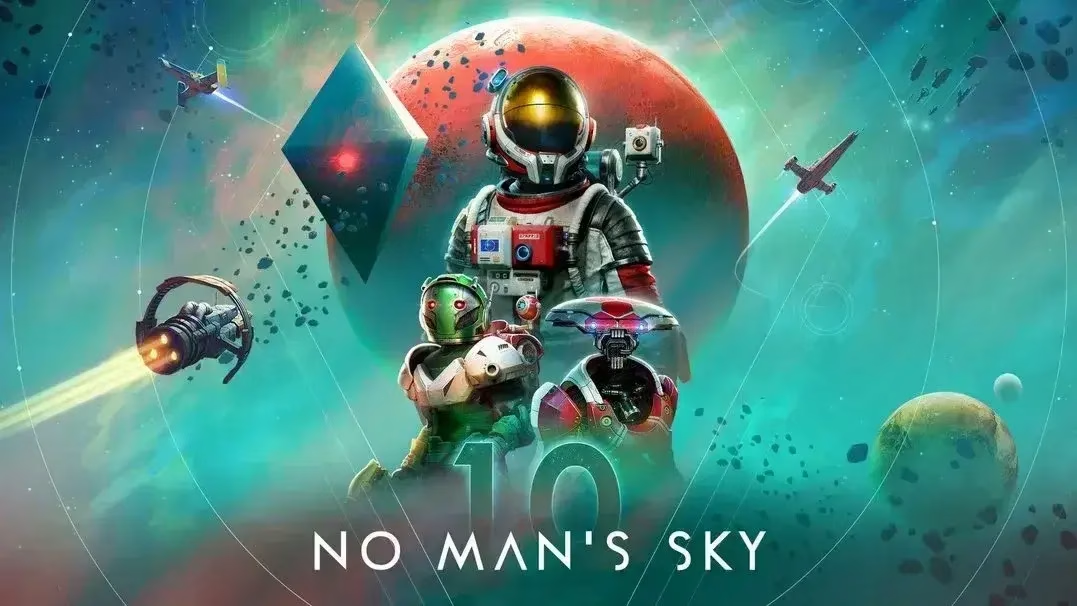
Ten years after its launch, No Man’s Sky continues to evolve at a pace that few games can claim today. Hello Games is celebrating the anniversary of its space adventure with Cosmos, a new free update intended to mark this particularly eventful decade. Initially released on August 9, 2016, for PlayStation 4 and PC, the title has gradually become one of the industry’s most notable examples of long-term support. Cosmos is set to introduce several improvements, changes and new features that should be of particular interest to long-time players, although the studio is still keeping the details of its content under wraps. Sean Murray, co-founder and director of Hello Games, nevertheless took advantage of the announcement to tease “big things” for the future of No Man’s Sky, suggesting that the game’s tenth anniversary is not an endpoint, but rather the beginning of a new stage.
Hello Games also shared some statistics offering an idea of the still-impressive scale of its procedural universe. Despite ten years of collective exploration, players are reportedly said to have discovered only around 1% of the planets available in No Man’s Sky. The figure is a reminder of how much the game’s generated vastness still exceeds what even a highly active community can explore. Sean Murray also points out that a large proportion of the developers working at Hello Games at the time of the 2016 launch are still with the studio, a relatively rare continuity for a project that has undergone such a transformation. Following a particularly controversial release, No Man’s Sky indeed built a second reputation through a succession of free expansions, major overhauls and new features that gradually brought the game closer to its initial ambitions while also adding systems that had not even been planned at the outset.
The journey is all the more remarkable given that No Man’s Sky’s first few weeks were marked by an extremely difficult reception. Many players notably criticized the game for lacking features that had been discussed before its release, including certain planetary physics mechanics, combat within atmospheres and deeper interactions between players. The community quickly compiled the differences between the pre-release presentations and the content actually available at launch, triggering a major wave of criticism. On Steam, this reaction caused the overall rating to fall into the “Mostly Negative” category. However, Hello Games chose to continue development rather than abandon the project. Over the years, free updates introduced new systems, reworked existing mechanics and considerably expanded exploration, construction, multiplayer and the possibilities offered by the universe. Ten years later, around 83% of Steam reviews are now positive, allowing the game to display an overall “Very Positive” rating.
This decade of evolution has also been accompanied by No Man’s Sky’s gradual arrival on new platforms, with Xbox, Nintendo Switch, PSVR and then Nintendo Switch 2 versions supplementing the PlayStation and PC editions. But Hello Games is already preparing its next major project. Sean Murray briefly discussed Light No Fire, the studio’s new game, which will likewise rely on procedural-generation technologies and sandbox mechanics, but in a very different setting: a single open world presented as a planet “the size of Earth.” The title is currently announced for PC and is not expected to release before 2027 at the earliest, although other platforms could be confirmed later. Until we learn more, Hello Games therefore seems far from having turned the page on No Man’s Sky: Cosmos is set to celebrate the ten years that have passed, while the mysterious “big things” promised by the studio suggest that space exploration still has several surprises in store.



Comments
Sign in with your Google account to leave a comment.