

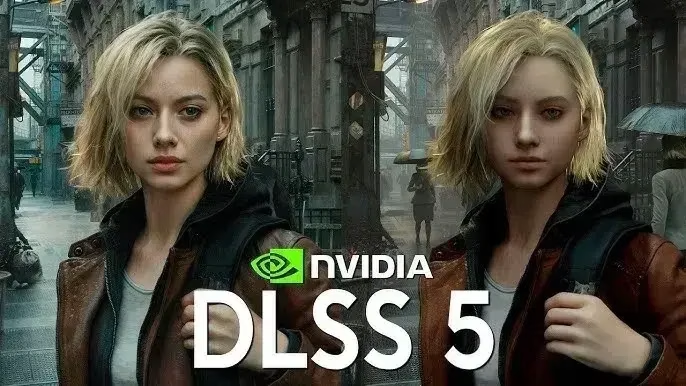
Nvidia continues to put AI at the heart of real-time rendering with DLSS 5, announced for fall 2026. Until now, DLSS technology—particularly since DLSS 3—has mainly become known for generating intermediate frames to smooth animation and boost performance. It is an approach that divides opinion: some denounce “fake frames,” while others see it as a pragmatic way to achieve high refresh rates on less powerful hardware.
With DLSS 5, the manufacturer promises a major change in scale: AI would no longer be limited to interpolation, but would also “polish” the appearance of each frame. According to Nvidia, the system uses information such as color and motion vectors to enhance lighting and materials, while remaining consistent from one image to the next. The stated goal is to achieve more photorealistic rendering and more stable character details, particularly for skin, hair and fabrics.
In its demonstrations, including a sequence from Resident Evil Requiem, Nvidia highlights improved lighting and material-light interactions, using a model trained to understand the “semantics” of a scene from a single frame. In other words, the AI would identify characters and lighting conditions—backlighting, overcast skies, and so on—then apply advanced rendering effects, such as subsurface scattering or subtle reflections on textiles, without distorting the original composition.
The question of visual perception remains. Some transformations can evoke a somewhat unreal aesthetic, almost “AI slop,” that clashes with the artistic direction intended by studios. Nvidia nevertheless assures that developers will retain creative control over the result when the feature is enabled. If the promise is fulfilled—real-time rendering at up to 4K and a qualitative improvement at limited cost—DLSS 5 could become a major driver in democratizing premium visuals without systematically requiring a GPU upgrade.




Comments
Sign in with your Google account to leave a comment.