


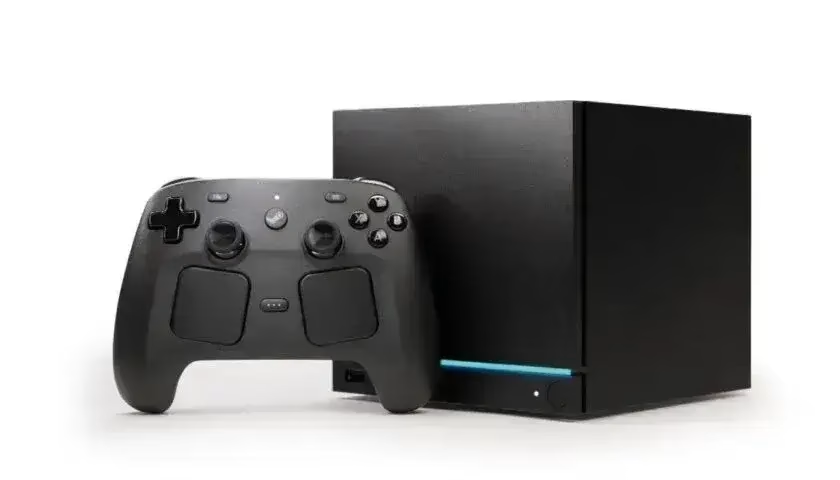
The new Steam Machine from Valve moves forward with a clear promise: to place SteamOS at the heart of the living room and offer an experience that is simpler than a traditional gaming PC while remaining more open than a conventional console. Presented as a compact 16.5 × 15.5 × 15.3 cm cube, the machine is aimed at players already invested in the Steam ecosystem, but its positioning remains delicate. Up against the PlayStation, Xbox, gaming mini-PCs and Steam Deck, Valve must justify the appeal of a fixed, preconfigured device designed for the television, but sold at a price well beyond the usual console territory.
In terms of hardware, the Steam Machine is based on a platform very close to that of a PC. It features a custom AMD processor with 6 cores and 12 threads, accompanied by 16 GB of DDR5 memory. Its Radeon graphics, based on the RDNA 3 Navi 33 architecture, come with 8 GB of GDDR6 memory and are close to a slightly scaled-down Radeon RX 7600, with 28 active compute units compared with 32 on the full card. The GPU operates within a 110-watt power envelope, below the 165 watts of a standard RX 7600. Storage reaches approximately 1.9 TB of NVMe on the tested model, while SteamOS 3.8.9 retains a Linux KDE desktop interface alongside the controller-focused gaming mode.
The Steam Machine’s performance places it well above the Steam Deck, but without representing a major breakthrough. Full HD and WQHD are the most suitable resolutions, while UHD quickly reveals the configuration’s limitations, particularly because of its 8 GB of VRAM. High settings can therefore become demanding depending on the latest games. The machine nevertheless stands out for its very quiet cooling, even under full load, as well as its comprehensive connectivity: HDMI 2.0, DisplayPort 1.4, four USB-A ports, one USB-C port, Gigabit Ethernet, Wi-Fi 6E, Bluetooth 5.3 and an integrated 2.4 GHz adapter for the new Steam Controller. This versatility confirms its PC DNA, even though the device remains less upgradeable than a custom-built configuration.
The main problem, therefore, remains the price. Starting at €1,040 without a controller, the Steam Machine clearly leaves console territory and finds itself competing with complete PCs, sometimes more upgradeable, available in a similar price range. For a player looking for an affordable entry point into gaming, a console remains the more rational choice. For a PC player, a Windows configuration or a self-built PC can offer greater flexibility. For a Steam Deck user, the OLED version accompanied by a dock retains a better mobility-to-price ratio. The Steam Machine will probably appeal to Valve fans, SteamOS enthusiasts and those who want a compact, elegant living-room PC, but its price severely limits its impact against already well-established competition.




Comments
Sign in with your Google account to leave a comment.